





Every unprotected loan file in your inbox is a liability waiting to be filed.

Business email compromise has overtaken ransomware as the #1 successful attack against financial services — and every income statement, ID scan, and bank record borrowers email you is fuel for it.

Scammers stole $152.6M from Australians using BEC attacks in 2024 — up 66% year-on-year.

(AFP / National Anti-Scams Centre)

email-cost2

$3.05B

reported BEC losses in 2025 — up ~10% in a single year (FBI IC3)

arrow-up-right2

+16%

YoY growth in BEC complaints — 24,768 reported in 2025 alone (FBI IC3)

insurance-claims2

60%

of 2024 cyber insurance claims traced back to BEC & funds-transfer fraud

cyber-attacks2

21% 

of successful cyberattacks are now BEC — overtaking ransomware at 16% (Microsoft, 2025)
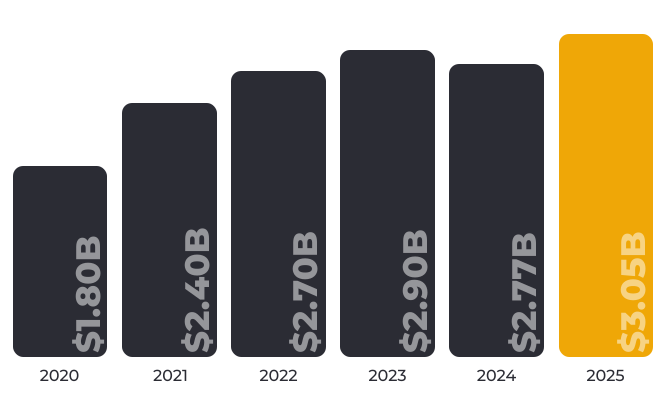
Reported losses are climbing toward a new record every year

The trend line has moved in one direction for six years straight, with 2025 marking the highest reported total yet.

Business Email Compromise:
reported losses, 2020–2025 (US$ billions)
Business email compromise graph

Source: FBI IC3 Internet Crime Reports, 2020–2025

Why lenders and brokers are being hunted specifically

Criminals have worked out where the richest, most concentrated files of personal information sit unprotected: loan application emails — payslips, ID scans, bank statements, credit reports — sitting in a mailbox with no access controls, no expiry, no audit trail.

  • Finsure (AU mortgage aggregator): ~300,000 customer/broker email addresses exposed in a cyber incident.
  • A finance-broker platform breach exposed 444,000+ borrowers’ government IDs, licences, and financial details collected for loan applications.
  • Latitude Financial: one compromised credential set led to 14 million records exposed across Australia and New Zealand
  • Q1 2026: financial services accounted for 44% of all confirmed ANZ data breaches — the most-targeted sector in the region (Cyble).

The rules are tightening, and the cost of doing nothing is rising

The rules are tightening fast
  • AU Cyber Security Act 2024: mandatory 72-hour reporting of ransomware/extortion payments for firms over $3M turnover.
  • AU Privacy Act penalties now reach $50M or 30% of turnover — ASIC already landed a $2.5M civil penalty for cyber failures.
  • NZ Privacy Act 2020: mandatory notification of any breach likely to cause serious harm — including PII sitting in email.
  • US: state privacy laws and breach-notification windows keep expanding for lenders operating across jurisdictions.
What it costs when you do nothing
  • 31% of financial services leaders admit they’re unprepared to recover from a BEC incident (Omega Systems, 2025).
  • BEC-driven claims already dominate the cyber insurance book — premiums, exclusions, and underwriting scrutiny only tighten from here for firms still emailing PII.
  • A single exposed loan file means a breach notification, a regulator conversation, a broker-channel reputational hit, and a possible penalty — multiplied across every file still moving through inboxes today.


pricing couple

FileInvite removes PII from the inbox entirely

Document requests, uploads, and sensitive files never touch email. Everything moves through a secure, access-controlled environment with permissioning, expiry, and a full audit trail — so there’s no unmanaged attachment left behind for an attacker, an auditor, or a regulator to find.

Sources: FBI IC3 2025 Report; Microsoft 2025 Digital Defense Report; Omega Systems 2025 Financial Services Cyber Resilience Report; Cyble ANZ Threat Landscape Report Q1 2026; Australian Federal Police / National Anti-Scams Centre, Targeting Scams Report 2024; public breach disclosures (Finsure, Latitude Financial, and related ANZ finance-broker incidents); Australian Cyber Security Act 2024 and Privacy Act amendments; NZ Privacy Act 2020.

Return to top